
Children don’t know how good they have it these days.
It’s something every older generation says, and for once, I think it’s actually true.
Life is easier now. Dramatically easier.
For most of human history, raising a family meant expecting loss. Before the 20th century, child mortality rates were so high that losing half your children wasn’t unusual. Families had ten or more children not out of abundance, but out of necessity.
My own grandmother was one of eleven. By the end of the First World War, only six remained. Five brothers gone in a few short years.
That was normal.
So of course, we moved in the opposite direction. We made life safer. Cleaner. More predictable. We built systems for food, water, shelter. We learned—eventually—not to poison ourselves with our own body waste. We created warmth at the touch of a button, light at the flick of a switch, food stored and ready whenever we want it.
Maslow’s hierarchy? For many of us, the bottom layers are not just met—they’re over-satisfied.
We live in comfortable “caves” now. And inside those caves, we’ve filled our lives with stimulation. Books, television, games, endless content from anywhere in the world. Anything we want, delivered before we’ve even finished clicking.
This is a world of instant gratification.
And the more we get, the more we seem to want.
We understand addiction in obvious forms—adrenaline junkies, runners chasing endorphins—but what about the quieter addictions? The endless scrolling, the shopping, the opinions, the distractions that require almost no effort at all?
We’ve made life so easy that we’ve quietly lost something important.
We’ve lost the ability to endure.
Let me tell you about my experience with Qigong.
When I first encountered it in the late 90s, I wanted answers. I wanted to understand what made it work—what made it real.
Instead, I found myself standing in a class with Master Lam, who told us almost nothing. He charged a lot, offered very little explanation, and yet… it felt authentic.
There are stories from China about students who would spend years sweeping floors, cooking meals, proving their dedication before a master would even acknowledge them.
That’s what it felt like.
I showed up. I practised. I struggled. And for a long time, I had no idea if I was getting anywhere. After about eighteen months, I’d had enough. I decided I was going to quit. It all felt like nonsense.
And then, just as I reached that point, he came over. He adjusted my posture—just slightly.
That was it.
But something changed. The sensation in my body shifted so dramatically it felt like I had crossed a threshold. Whether it was his Qi or mine didn’t matter. What mattered was that something real had happened.
And it only happened because I stayed.
Later, I trained under another teacher. On the first day of a retreat, he had us do an exercise called Chen Qi.
On the surface, it looks simple—just repeated shoulder movements. In reality, it’s brutal.
We started with twenty minutes.
The room was full of experienced students and teachers, and within minutes we were all in serious discomfort. But no one stopped. No one questioned it.
Day after day, we did the same.
He had explained something beforehand—the “bell curve of pain.” The idea that sensation rises, intensifies, peaks… and then, if you stay with it, begins to dissolve.
At the time, it sounded theoretical. Then I experienced it.
The pain built and built until it felt unbearable—and then, unexpectedly, it softened. My shoulders opened. The tension released in a way I had never felt before.
And it stayed that way. It changed my practice permanently.
Afterwards, I joked with him that I would never start a class like that. My students would leave.
He looked at me and said, completely seriously:
“That’s exactly why I do it. If they can’t handle a bit of discomfort, I don’t want them as students.”
That’s the difference.
Qigong hasn’t become easier.
We have.
I’ve had many students tell me, “This is exactly what I need. I believe this will help me.”
And then they disappear after two or three weeks.
Not because it doesn’t work—but because it’s uncomfortable. Because it requires patience. Because results don’t arrive instantly.
We’ve been trained, consciously or not, to expect ease.
To expect answers immediately.
To move on when something feels difficult.
I’m not saying people shouldn’t explore. There are many valid paths—Qigong, yoga, meditation, different teachers, different systems.
But there’s a difference between exploring and constantly switching.
At some point, you have to choose.
And once you choose, you have to stay.
Through the boredom. Through the doubt. Through the discomfort. Through the pain.
Because that’s where the change happens.
This isn’t just about Qigong.
You can see it everywhere.
Young people today are growing up in a world with more comfort and more choice than ever before—but also more confusion. Endless options, endless voices, endless distractions pulling them in every direction.
How do you choose a path when everything is available?
How do you commit when there’s always something new promising faster results?
There are still incredible young people doing meaningful, focused work. But there are also many who feel lost, overwhelmed, or stuck – caught between comfort and uncertainty.
Without pressure, without necessity, it becomes harder to develop direction.
Harder to build resilience.
Harder to stick with anything long enough to see it through.
So, what’s the answer?
It’s not to reject comfort entirely. We’re not going back to medieval hardship, nobody needs to become a Monk!
But we do need to reintroduce something we’ve lost.
Deliberate difficulty.
Choosing things that challenge us. Staying with them when they stop being enjoyable. Letting discomfort teach us rather than avoiding it.
Qigong is one of those tools.
It’s not easy. It was never meant to be.
But if you stay with it—really stay with it—it will change you.
Finding your path isn’t simple.
You might need to try different things. Different environments. Different types of work. You might need to travel, to experiment, to fail a few times.
But eventually, something will resonate.
And when it does—dig in.
Don’t look for shortcuts. Don’t expect instant results. Accept that it will be difficult at times.
That’s not a flaw in the system.
That’s the point.
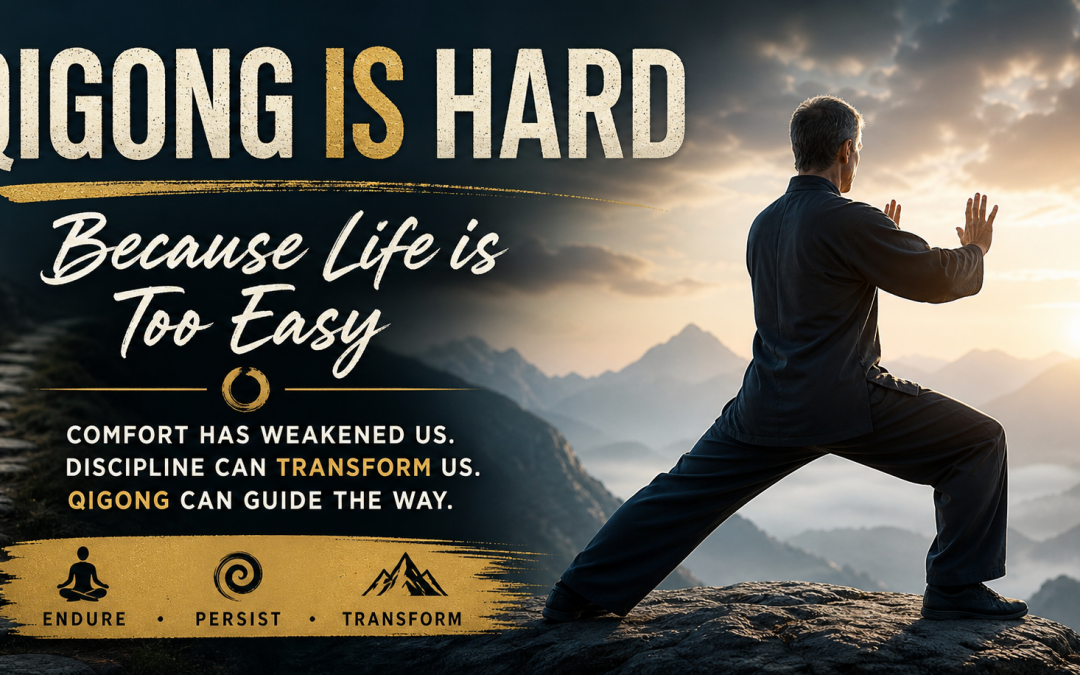
Qigong is hard.
But that’s exactly why it’s valuable.
And if you’re willing to give it the time it deserves, it can take you much further than you expect.
Hao La.
Everything is good already.
